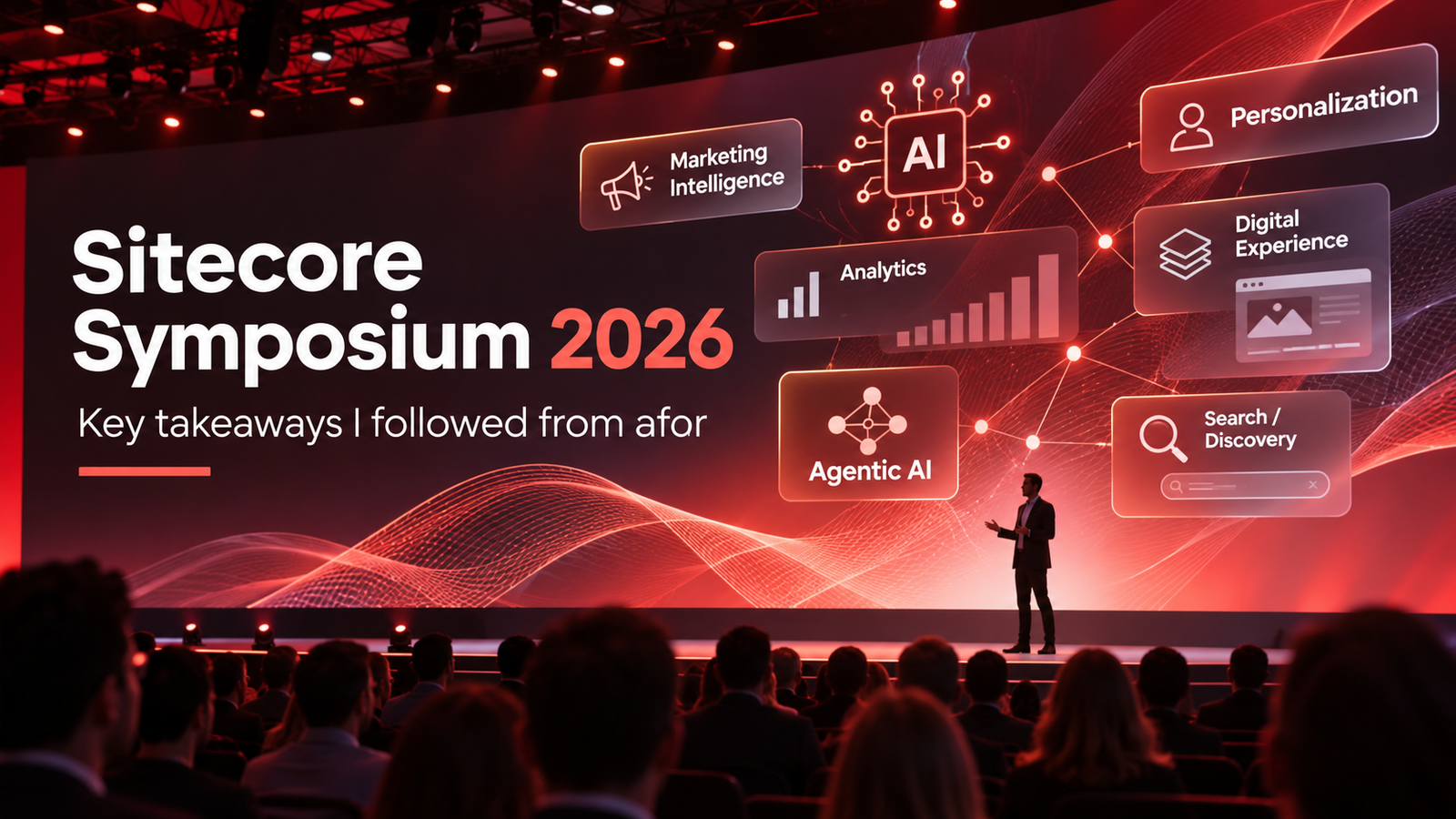
From AI-powered discovery to agentic marketing, Sitecore Symposium 2026 offered a glimpse into where digital experiences are heading next.
For someone who has been part of the Sitecore ecosystem for many years, Sitecore Symposium has always been more than just another technology conference. It’s an opportunity to reconnect with the community, exchange ideas, and understand where the digital experience industry is heading.
Unfortunately, I couldn’t make it to Orlando this year.
And yes, I did miss the conversations, the familiar faces, and the energy that comes with bringing the Sitecore community together.
But thanks to the announcements, community discussions, and perspectives shared by fellow Sitecore enthusiasts, I’ve been catching up on what happened at Sitecore Symposium 2026, held November 10–12 under the theme Marketing Rewired.
A few developments particularly caught my attention.
1. MarketingIQ: Moving from AI Insights to AI-Driven Execution
One of the biggest announcements was the introduction of Sitecore MarketingIQ.
We’ve spent the last couple of years discussing how AI can help marketers generate content, personalize experiences, and improve productivity.
MarketingIQ appears to take this conversation further.
Rather than simply helping marketers understand what’s happening, it aims to connect market intelligence, brand context, AI agents, and campaign execution.
Imagine identifying a gap in how your brand appears in AI-generated answers, understanding why that gap exists, and then orchestrating the content and marketing activities needed to address it.
All while keeping marketers involved in reviewing and approving the work.
What interests me most is the shift from AI as a productivity assistant to AI as an orchestration layer for marketing operations.
Of course, the real test will be how effectively these capabilities work across complex enterprise environments, where content, data, governance, and technology often sit across multiple platforms.
2. AI Discovery Is Changing the Customer Journey
This was probably the most interesting development for me personally.
Research shared by Scrunch Labs during Symposium revealed that 40.8% of AI assistant sessions are entirely self-contained, with no web search beforehand and no website click afterward.
Another fascinating finding was that approximately 91% of the increase in website visits following an AI brand recommendation arrives without an identifiable AI referral source.
Think about what this means for traditional digital marketing measurement.
For years, we’ve relied on organic traffic, search rankings, referrals, and conversions to understand how customers discover our brands.
But what happens when customers discover, evaluate, and shortlist brands inside AI conversations?
And what happens when AI influences a purchase, but traditional analytics cannot accurately attribute that influence?
This reinforces something I’ve been advocating in my work around Answer Engine Optimization (AEO) and Generative Engine Optimization (GEO).
Visibility can no longer be measured by search rankings and website traffic alone.
Brands increasingly need to understand whether AI platforms recognize them, recommend them, cite them, and represent their products accurately.
This is becoming an important addition to the digital discoverability conversation.
3. From Search Engine Optimization to Agent Experience Optimization
Another recurring theme was the growing importance of AI agents.
Today, we are primarily focused on helping AI systems discover and recommend our brands.
Tomorrow, those same systems could be interacting with websites, comparing products, registering customers, and completing transactions on their behalf.
This introduces an interesting question.
Are our digital experiences being designed only for humans, or are we preparing them for AI agents as well?
Traditional website experiences have been optimized around human navigation, visual design, and conversion journeys.
Agentic experiences will demand additional considerations: structured information, machine-readable content, trusted product data, accessible functionality, and clearly defined permissions.
I found the discussion around agent-ready experiences particularly relevant.
The next evolution of digital experience platforms may not simply be about delivering better websites.
It may be about enabling both humans and intelligent agents to discover information and complete meaningful actions.
4. The Scrunch Integration Makes AI Visibility More Actionable
Sitecore’s integration of Scrunch into its broader ecosystem is another development worth watching.
One of the challenges with AEO and GEO today is that brands have access to increasingly sophisticated visibility tools, but translating those insights into meaningful action remains difficult.
Knowing that a competitor is being recommended more frequently is useful.
Understanding which sources influence those recommendations is even better.
But connecting those findings to content improvements, digital asset management, publishing workflows, and measurable business outcomes is where things become truly interesting.
The Symposium discussions around citation optimization and third-party brand authority also reinforced an important point.
Your brand’s AI visibility isn’t determined solely by what you publish on your own website.
Reviews, independent publications, authoritative mentions, and other external sources increasingly influence how AI systems understand your brand.
In other words, AEO isn’t simply a new version of technical SEO.
It requires a broader approach to digital authority, content governance, and brand presence across the web.
5. Enterprise Content Governance Becomes Even More Important
One theme connecting many of these announcements is the importance of trustworthy, structured, and approved content.
AI agents can accelerate content creation and marketing execution.
But they can also amplify inconsistencies.
Imagine an AI system encountering conflicting product information across different regional websites, outdated claims, or content that has not been reviewed for compliance.
For enterprises managing hundreds of websites across multiple markets, these are not hypothetical challenges.
They are everyday operational realities.
As AI becomes more deeply embedded in digital experience platforms, I believe content governance, privacy, accessibility, and digital trust will become even more important.
The effectiveness of AI will ultimately depend on the quality and reliability of the information it can access.
AI can accelerate execution. It cannot compensate for poor digital foundations.
6. The Bigger Shift: From Managing Digital Experiences to Orchestrating Outcomes
Looking across the announcements, I see a broader transformation taking shape.
Digital experience platforms have traditionally focused on enabling organizations to create, manage, personalize, and deliver digital experiences.
The emerging direction appears to be different.
Platforms are increasingly trying to understand market signals, recommend actions, coordinate workflows, and connect marketing activities to measurable outcomes.
This raises important questions for digital leaders.
How should marketing and technology teams evolve? What capabilities should remain under human control? How do we balance automation with governance? And how do we measure success when AI increasingly influences customer decisions outside traditional digital channels?
These are conversations worth having, regardless of which technology platform an organization uses.
Looking Ahead
Although I missed Sitecore Symposium 2026 in person, following the announcements reminded me why I’ve enjoyed being part of this community for so many years.
The Sitecore ecosystem continues to evolve, and so do the conversations around digital experiences.
For me, the most exciting development isn’t any single product announcement.
It’s the convergence of AI-powered discovery, agentic experiences, content intelligence, and marketing orchestration.
We are moving toward a world where digital platforms won’t simply manage experiences. They will increasingly help organizations identify opportunities, make informed decisions, and act on them.
The challenge for enterprises will be translating these innovations into scalable, governed, and measurable business outcomes.
Congratulations to the Sitecore team, speakers, MVPs, and community members who made Symposium 2026 possible.
I may have missed Orlando this year, but I’m certainly looking forward to continuing these conversations with the community.
The future of digital experience isn’t just about being found. It’s about being understood, trusted, recommended, and increasingly, being actionable.
And that is a conversation worth following.
