
If you spend ten minutes on LinkedIn today, you will notice something fascinating.
Suddenly everyone is an AEO expert.
Answer Engine Optimization.
The discipline that promises to help brands appear inside AI-generated answers from systems like ChatGPT, Google AI Overviews, and Perplexity.
Consultants are updating their titles.
Agencies are launching new service pages.
SEO professionals are rushing to add “AEO strategist” to their bios.
The gold rush has begun.
And yet, something about this moment feels strangely familiar.
The Same Pattern We Have Seen Before
The digital industry has a remarkable ability to reinvent expertise overnight.
When Google launched PageRank, SEO experts appeared everywhere.
When Facebook advertising took off, social media gurus multiplied.
When generative AI exploded, AI consultants emerged across every discipline.
Now it is AEO.
The pattern is predictable.
A new platform emerges.
Algorithms change.
Information distribution evolves.
And suddenly an entire industry rushes to rename itself.
But beneath the excitement lies a quieter truth.
Most of what is required to succeed in AEO is not revolutionary.
In many ways, it is simply a return to principles that the industry neglected for years.
The Forgotten Foundations of SEO
For over a decade, SEO became increasingly tactical.
Teams obsessed over keyword density.
They built content farms.
They chased backlinks at scale.
They produced thousands of pages optimized for search engines but barely useful to humans.
The result was predictable.
The web filled with content that ranked well but answered very little.
Ironically, the arrival of AI-driven answer engines is forcing the industry to rediscover what search was always supposed to be about:
Clear answers.
Trustworthy sources.
Structured information.
Real expertise.
In other words, the fundamentals.
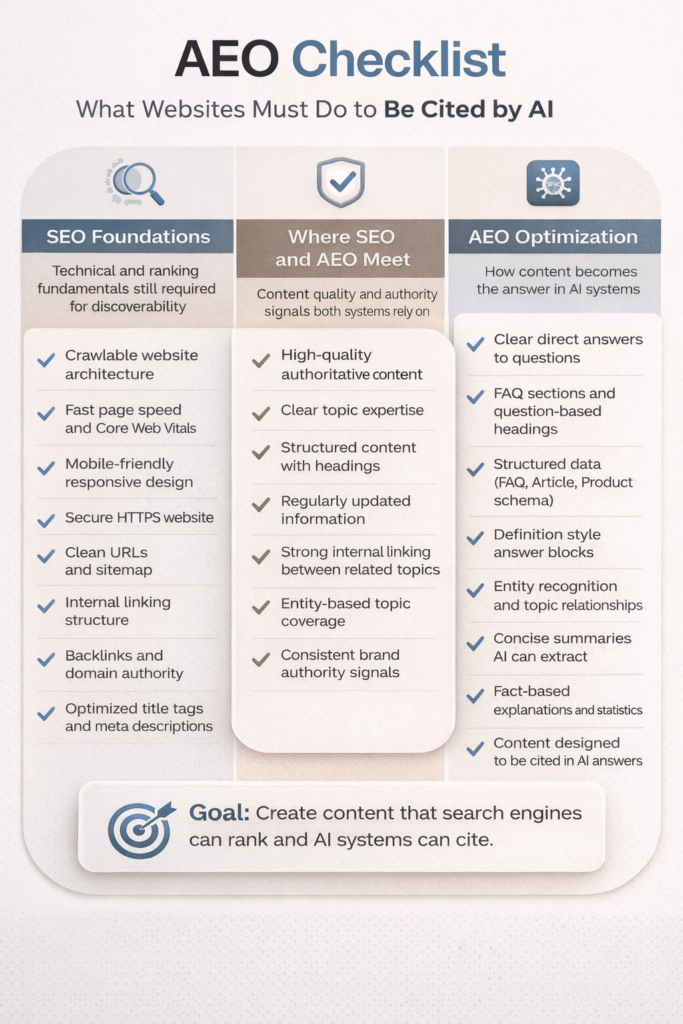
Here is a quick AEO checklist you would want to follow:
Why Answer Engines Reward Substance
Traditional search engines ranked pages.
Answer engines synthesize knowledge.
That difference matters.
When an AI system generates an answer, it is not looking for the page with the most keywords.
It is looking for signals that help it determine:
Who understands this topic?
Which source explains it clearly?
Where is the information structured in a way machines can interpret?
This changes the game.
Thin content becomes invisible.
Vague marketing language disappears.
Authority, clarity, and structure suddenly matter far more than keyword tricks.
The Real Principles Behind AEO
Despite the hype, AEO is not magic.
It emerges from a few simple ideas that blend classic SEO discipline with new machine-readable signals.
Strong AEO content tends to share several characteristics.
It answers real questions directly.
It is written by identifiable experts or trusted entities.
The information is structured clearly using headings, schema, and contextual signals.
Concepts are explained in a way that machines can extract and summarize.
The content exists within a broader ecosystem of related knowledge rather than isolated pages.
In other words, the best AEO strategies do not start with algorithms.
They start with clarity of thought.
The New Signals Answer Engines Pay Attention To
While many fundamentals remain the same, answer engines do introduce new dynamics.
Large language models rely heavily on semantic relationships between topics.
They learn from patterns across massive corpora of information.
This means brands need to think less about individual keywords and more about knowledge architecture.
Entities become more important than phrases.
Context becomes more important than density.
Structured explanations become more valuable than long, meandering articles.
The web is slowly shifting from a keyword index to a knowledge graph.
AEO lives in that transition.
The Danger of the New AEO Industry
The risk in moments like this is not innovation.
It is oversimplification.
Some consultants will promise shortcuts.
Some tools will claim instant visibility in AI answers.
Some agencies will repackage traditional SEO services with new terminology.
But visibility in answer engines ultimately depends on something harder to fake:
Credible knowledge.
Structured expertise.
Consistent authority over time.
There is no prompt that can replace that.
The Real Opportunity
For organizations that ignored SEO fundamentals in the past, this shift creates a second chance.
AEO rewards the companies that invest in:
Clear knowledge hubs.
Authoritative subject matter experts.
Structured explanations of complex topics.
Content ecosystems rather than isolated pages.
In many ways, the future of discoverability looks less like marketing and more like publishing.
Brands that behave like trusted knowledge sources will win.
Those chasing algorithm tricks will fall behind again.
The Race Will Settle
Right now, the industry is in the excitement phase.
Everyone wants to be early.
Everyone wants to claim expertise.
But over time, the race will settle.
Just as SEO eventually separated real practitioners from opportunists, AEO will do the same.
Because the truth is simple.
Answer engines are not rewarding clever optimization.
They are rewarding clear answers.
And the brands that learn to provide them consistently will not need to call themselves AEO experts.
Their visibility will speak for itself.